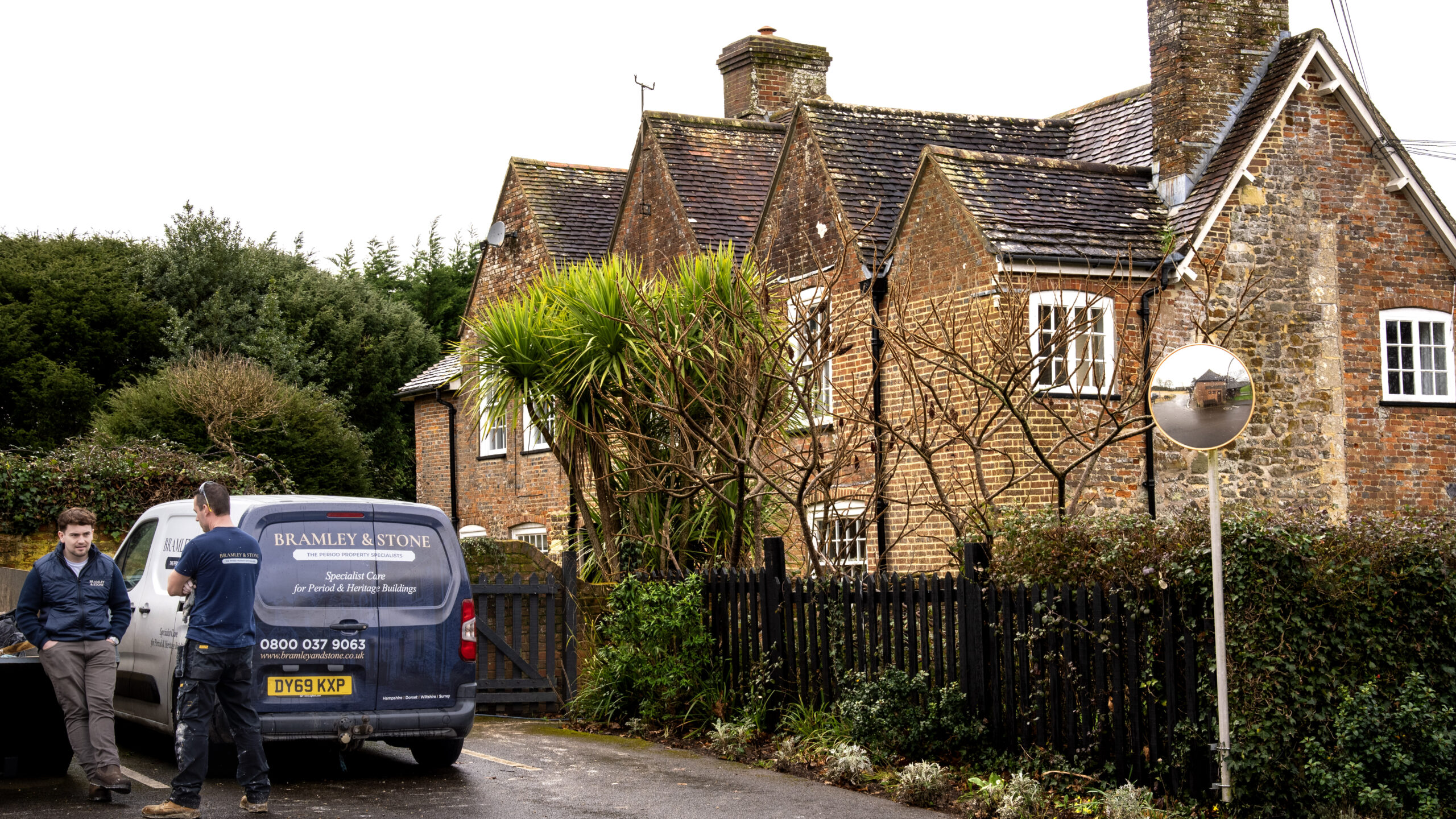
Damp Specialists For Period Properties In Hampshire
The damp has come back. You’ve had it “treated” before – perhaps more than once – and the patches, the smell and the cold walls are still there. You suspect the last contractor didn’t understand your building.
Bramley & Stone are heritage damp specialists working across the whole of Hampshire. We diagnose the actual cause of damp in period properties and remediate it using breathable, traditional materials. No chemical injections. No waterproof tanking on solid walls. No quick fixes that fail in three years. We’ve assessed and restored over 1,500 period properties, we follow the SPAB approach to repair, and we hold public liability insurance up to £5 million.
Covering Winchester, Romsey, Petersfield, Alton, Alresford, Andover, Lymington, Ringwood, Bishop’s Waltham, Hook and surrounding villages
Damp In Hampshire's Period Property Stock
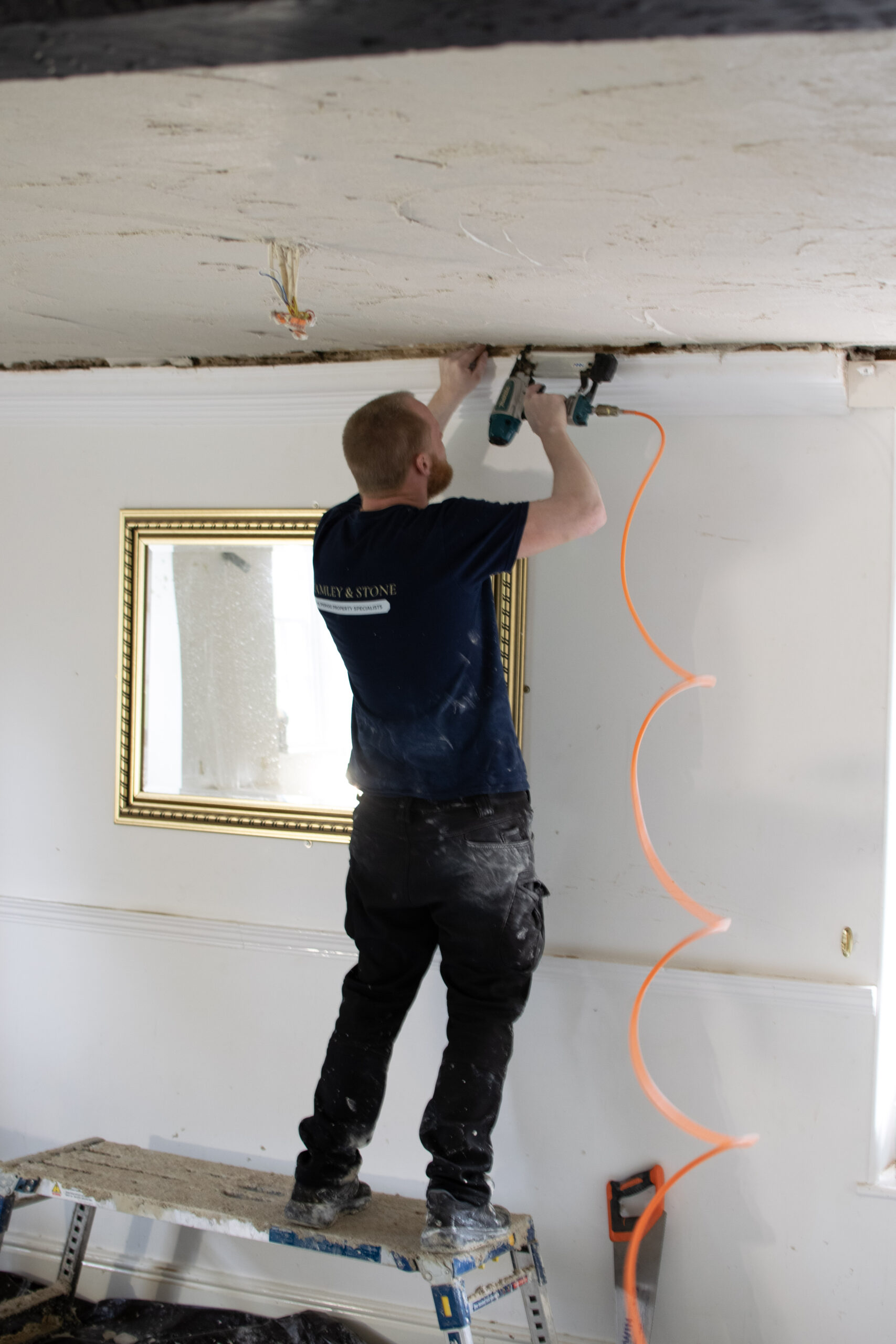
Hampshire has a distinctive heritage building stock, and the damp problems we encounter across the county reflect the materials and methods that define it. In over a decade of working exclusively on period and listed properties, we’ve seen the same patterns repeat across every type of Hampshire construction – and the same misdiagnosis repeated by damp-proofing companies who treat old buildings as if they were modern ones.
The Georgian and earlier properties of Winchester – one of the most architecturally significant cities in southern England – were built in soft brick, flint, and local stone, bonded with lime throughout. The market towns of Romsey, Petersfield, Alton and Alresford carry fine Georgian brick stock alongside older timber-framed buildings. The flint and brick-and-flint cottages and farmhouses of the chalk downland – across the north of the county, the South Downs villages, the Meon Valley and the Test Valley – are built in the characteristic Hampshire vernacular, with knapped or whole flint set in substantial lime mortar. The timber-framed buildings of the older towns and villages – close-studded, wattle-and-daub infilled, often jettied – represent some of the oldest surviving stock in the county. And across the eastern fringe towards the Surrey border, around Selborne and Petersfield, malmstone – the soft local greensand – appears as a distinctive regional building material.
Across all of these property types, the same pattern repeats. Damp appears. A damp-proofing company is called. Chemical injection is sold. Internal walls are stripped and re-plastered with gypsum or waterproof render. The damp returns, sometimes within months. And the underlying cause – usually cement, usually trapped moisture, usually a fixable problem in the building’s external fabric – is never addressed.
We exist to break that cycle. We diagnose what’s actually wrong, and we remediate the cause.
Why Damp Behaves Differently In Hampshire’s Old Buildings
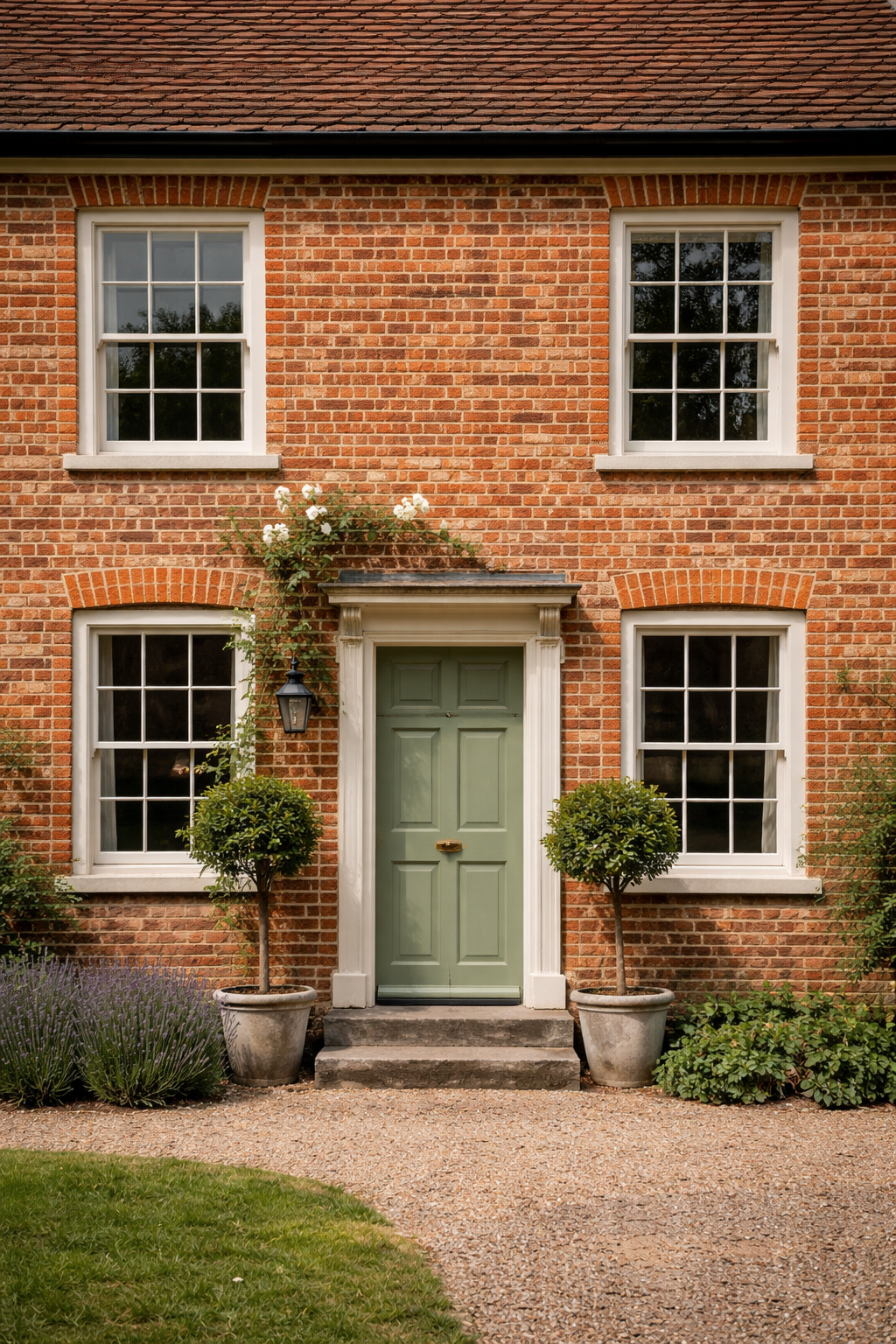
The principle that old buildings manage moisture through breathability applies everywhere. The reasons it plays out the way it does in Hampshire specifically are worth setting out.
Solid walls and breathability are the rule.
Almost every pre-1919 property in Hampshire has solid walls – no cavity, no modern damp proof course, no impermeable membrane. Moisture management depends entirely on the wall absorbing small amounts of water and releasing it again through breathable lime mortar, breathable lime plaster internally, and breathable lime render externally where present. When that system is broken, damp follows.
Flint construction concentrates particular issues
Hampshire is chalk country, and flint is the dominant traditional walling material across much of the county. Flint walls hold a substantial body of lime mortar between the cobbles – the mortar is doing significant structural and moisture-management work. When that mortar has been replaced with cement, or has weathered and failed, flint walls develop their own characteristic damp problems: moisture accumulating between the flints and the impermeable cement, salt staining on internal faces, and a wall that can no longer manage the water it absorbs.
Timber-framed buildings have specific vulnerabilities
Hampshire’s surviving medieval and Tudor timber-framed buildings depend on the breathability of their wattle-and-daub or lime-plaster infill panels, and on the ability of the whole structure to release moisture. Cement render applied over a timber frame, or modern impermeable infill panels, traps moisture against the historic timber – accelerating decay in exactly the structural elements that matter most.
Raised ground levels and bridged DPCs are widespread.
Across Hampshire’s period stock, patios, drives, paths and landscaping have often been raised over the decades until they sit above the original DPC line – or above the lowest course of breathing masonry where there is no formal DPC. This bridges the building’s defence against ground moisture and is one of the most common causes of “rising damp” diagnoses in the county. It is not rising damp. It is a fixable external issue.
Subfloor ventilation is frequently blocked.
Period properties across Hampshire typically have suspended timber ground floors over ventilated voids, with airbricks around the perimeter. When those airbricks are blocked, painted over, rendered across or buried by raised ground levels, the void stops venting, moisture accumulates beneath the floor, and damp rises into the lower walls. The fix is to restore ventilation – not to seal the floor.
Listed buildings concentrate in specific areas
Winchester above all, but also Romsey, Petersfield, Alresford, Titchfield, Wickham and dozens of village conservation areas across the county carry significant listed building stock. Listed status changes the legal framework around damp work – chemical injections and waterproof renders are increasingly unlikely to be consented, and using them inappropriately can breach existing consent and create liability for the owner.
Read the full diagnostic guide on our Damp Remediation →
The Five Real Causes Of Damp We See Across Hampshire
In the period properties we’ve surveyed across Hampshire, the actual cause of damp almost always falls into one of five categories. None of them are solved by a chemical damp proof course.
Penetrating damp from failed external details.
Blocked or leaking gutters, cracked downpipes, failed flashings around chimneys and parapets, raised external ground levels above the original DPC line. The first thing we look at on every Hampshire survey is where rainwater is actually going. On flint properties especially, failed pointing in the flint work allows water directly into the wall body – and on the chalk downland, exposure to driven rain finds every weakness in the external envelope.
Cement render and pointing trapping moisture
Probably the single most common cause we encounter in Hampshire. Cement render applied during the post-war decades to Georgian, Victorian and earlier properties – across Winchester, the market towns, the flint villages – traps moisture inside the masonry. Internal damp follows as the wall pushes moisture inward. Removing the cement and reinstating lime is often the single most effective intervention possible. We documented exactly this work on a Georgian property in Hook, where the cement had bonded so aggressively to the soft brick that pieces of the brick face came away with it.
Internal tanking and waterproof plaster systems
Properties that have had basement tanking, cementitious waterproof render or impermeable membrane systems applied internally tell the same story across Hampshire. The wall can’t release moisture, salts accumulate behind the system, and eventually the surface fails or the damp emerges above the tanked line. We remove failed tanking and reinstate breathable lime.
Condensation misdiagnosed as rising damp
Particularly common in properties that have been heavily draught-proofed during recent decades – sealed chimneys, blocked airbricks, gypsum-skimmed walls, modern double-glazing replacing leaky sashes. The building can no longer ventilate, and moisture from daily living condenses on cold internal surfaces. The damp pattern looks like rising damp at the base of walls, but a chemical injection won’t fix it.
Subfloor moisture from blocked ventilation, and decay in timber-framed buildings.
In suspended-floor properties, blocked airbricks prevent the void from venting and moisture accumulates beneath the floor. In timber-framed buildings, trapped moisture from cement render or impermeable infill panels accelerates decay in the historic frame. Both have the same root cause – the building can’t release moisture – and the same fix: restore breathability.
Read the full diagnostic guide on our Damp Remediation →
What Standard Damp Treatments Do To Hampshire's Old Buildings
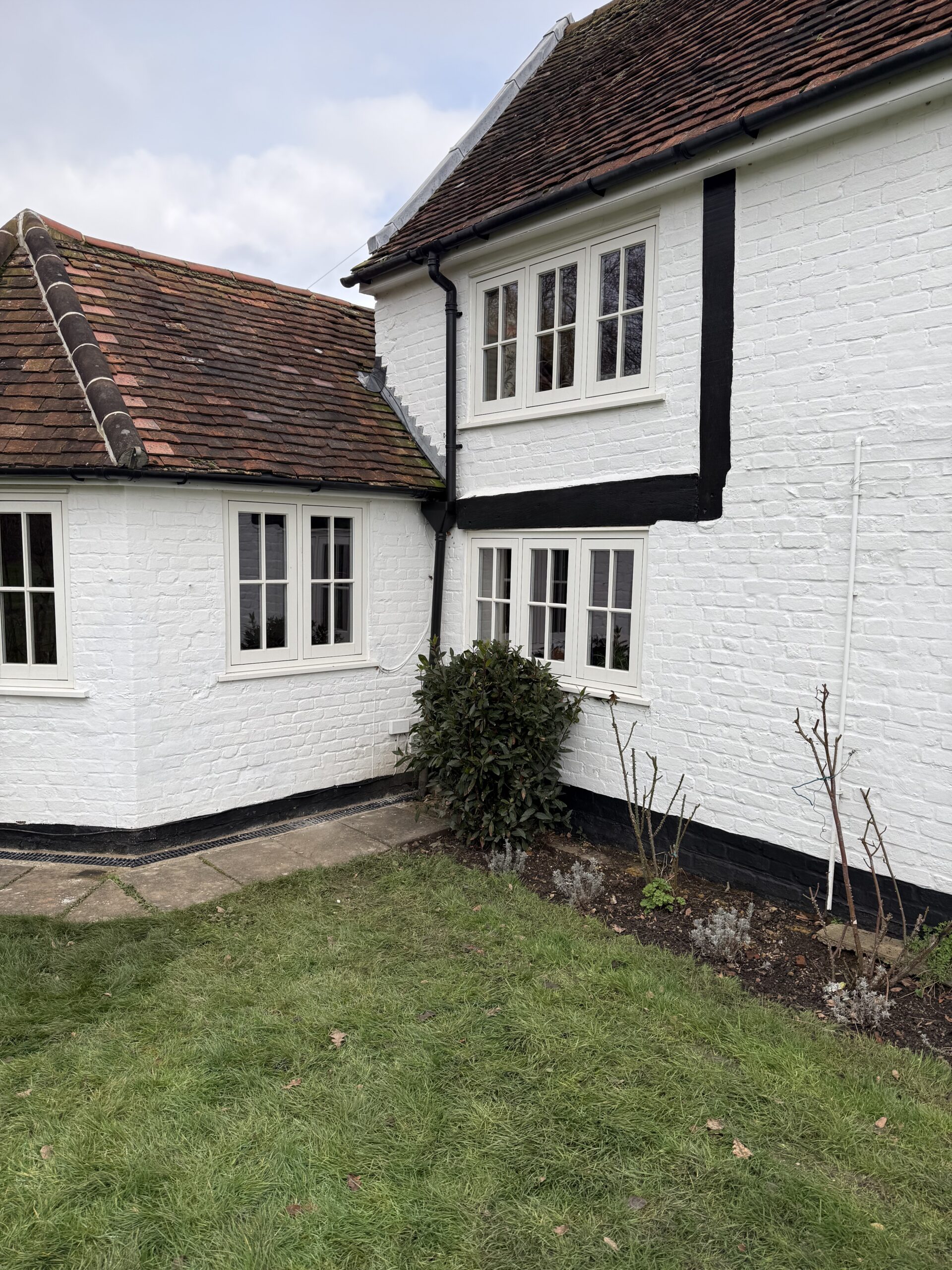
Before we explain what we do, it’s worth being specific about what the wider damp-proofing industry does to period properties across Hampshire, and why these approaches fail.
Chemical damp proof course injection is the most commonly sold “solution” in the county – and the most commonly inappropriate. The injection targets a problem (true capillary rising damp) that is far rarer than the industry presents. In most Hampshire period properties we survey, the actual cause is something else – and the injection leaves it untouched.
Waterproof cement render and tanking seal moisture out of, or into, the wall. On a Hampshire solid-walled cottage or flint property, this prevents the wall from working as it was designed to. The moisture accumulates behind the render until it finds another exit – often above the tanked line, often through the surface as crystallised salts.
Gypsum plaster on lime substrates is one of the most common things we strip out of Hampshire properties. Vinyl emulsion paint over lime plaster is another. Both are vapour-resistant; both prevent the wall from breathing; both cause the underlying lime substrate to fail.
Cement repointing on lime-built masonry is widespread across Hampshire – particularly damaging on flint walls and soft brick. The cement is harder than the surrounding material, blocks the moisture-release route, and accelerates erosion of the masonry itself.
We don’t apply any of these to Hampshire’s period properties. We remove them.
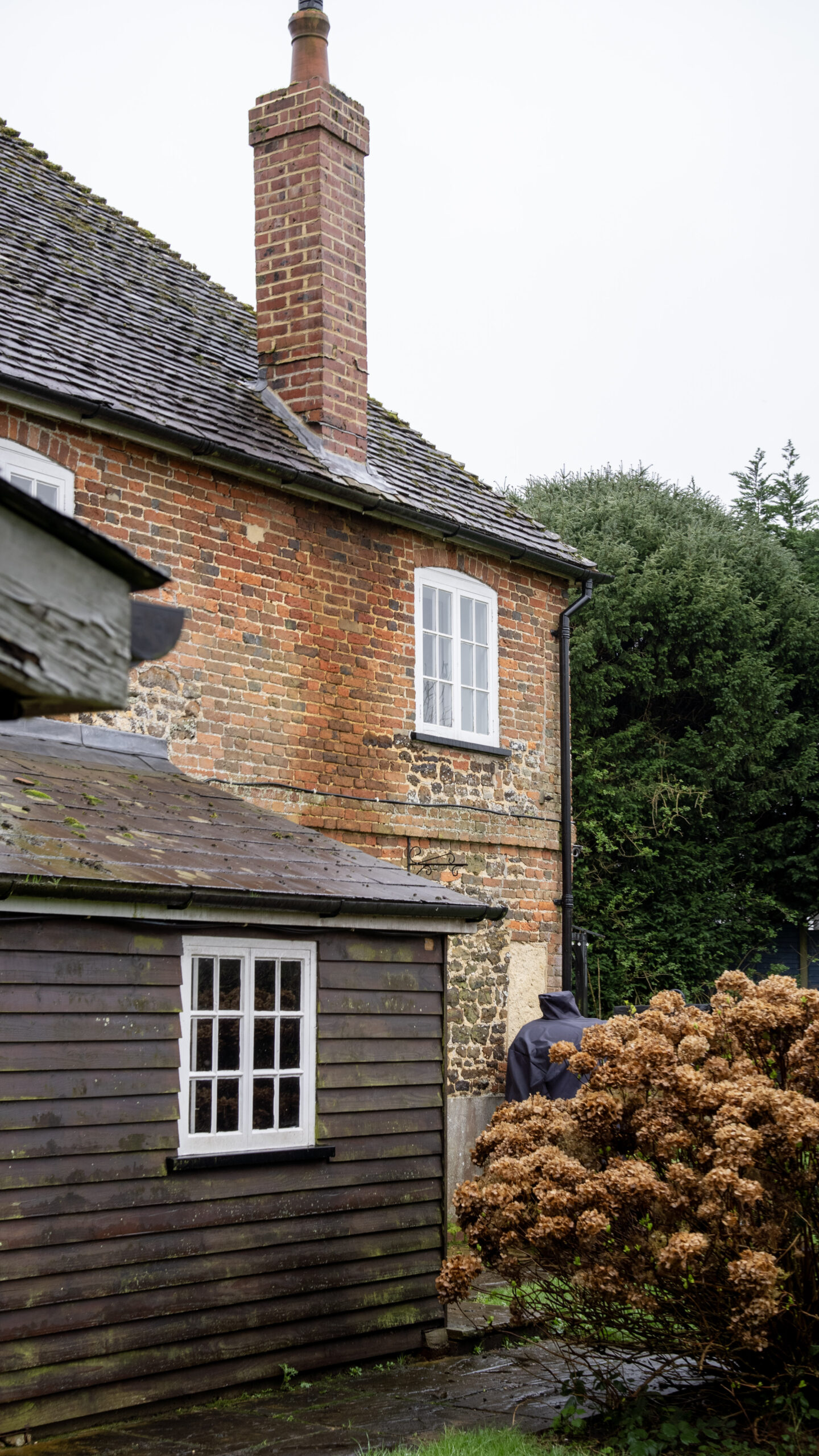
How We Remediate Damp In Hampshire Properties
Every survey is different, but the process is the same:
Heritage damp survey. A specialist surveyor visits the property and assesses both the internal symptoms and the external causes. We look at construction type, wall build-up, existing finishes, ground levels, guttering and external details, ventilation, sub-floor voids, evidence of previous interventions, and the specific pattern of damp. Where appropriate we use moisture meters, thermal imaging and calcium carbide testing. The survey is diagnostic – we’re working out what’s actually wrong, not selling a treatment.
Written report and clear specification. You receive a written report in plain English that sets out what we found, what we believe is causing the damp, and what we recommend. If we think a previous contractor’s work is making things worse, we say so. If we think the problem is smaller than you feared, we say that too. The quotation that follows is specific and itemised.
Remediation using breathable materials. Cement render removal where it’s contributing to the damp. Failed gypsum or modern plaster stripped and replaced with three-coat lime plaster. Failed tanking removed carefully and lime-rendered behind. External details – gutters, ground levels, flashings – addressed where they’re part of the cause. Sub-floor ventilation restored. Lime mortar repointing where required, including specialist flint repointing. All using materials matched to the property’s age and construction.
Long-term protection. What you’re left with is a building that can manage moisture the way it was designed to. The walls breathe, the surfaces stay dry, the rooms feel warmer. Qualifying works are backed by our 10-year workmanship promise.

Areas Of Hampshire We Cover
We carry out heritage damp remediation across the whole of Hampshire:
Central Hampshire – Winchester, Alresford, and the surrounding downland villages.
North Hampshire – Andover, Whitchurch, Basingstoke, Odiham, Hook, Hartley Wintney, Overton and the village stock across the north of the county.
East Hampshire – Petersfield, Alton, Selborne, Liss, and the greensand and chalk villages towards the Surrey border.
The Test Valley – Romsey, Stockbridge, Andover and the test valley villages.
The Meon Valley and south Hampshire – Bishop’s Waltham, Wickham, Botley, Hambledon and the Meon Valley villages.
The New Forest fringe and the south-west – Lymington, Ringwood, Fordingbridge, Brockenhurst and the New Forest villages.
South coast Hampshire – Fareham, Titchfield, Southampton, Portsmouth and the surviving heritage stock of the south coast.
If your Hampshire village isn’t listed, please get in touch – we cover the whole county.

What Happens Next
Step one – An Initial Conversation.
Call 01202 144776 or submit an enquiry. We’ll come back to you to understand what you’re experiencing, what’s already been tried, and whether a heritage damp survey is the right next step.
Step two – A Heritage Damp Survey.
A specialist surveyor visits the property and carries out a diagnostic assessment. There is a fee for the survey, which reflects the time and expertise involved.
Step three – Written Report and Quotation
A specific written report with our findings and recommendations, plus an itemised quotation. You’re under no obligation to proceed.
Step four – The Work
If you go ahead, we schedule the project, agree start dates, and our team carries out the work. Qualifying works are backed by our 10-year workmanship promise.
Book a Heritage Damp Survey — Call 01202 144776
Frequently asked questions
In the period properties we survey across Dorset, the actual cause of damp almost always falls into one of five categories. None of them are solved by a chemical damp proof course.
I’ve had damp treatment in my Hampshire property and it’s come back. What’s gone wrong?
Almost always, the cause of the damp wasn’t identified before the treatment was applied. Standard damp treatments – chemical injection, internal tanking, waterproof render – assume the cause is true rising damp. In most period properties in Hampshire, the actual cause is something else entirely: cement render trapping moisture, a bridged DPC, blocked subfloor ventilation, failed flint pointing, or condensation. The treatment seals over the symptom but leaves the cause in place, so the damp reappears.
Is rising damp actually real in Hampshire’s old buildings?
Genuine capillary rising damp through solid masonry does exist, but it’s far rarer than the damp-proofing industry suggests. In the period properties we’ve surveyed across Hampshire, the cause of “rising damp” diagnoses has almost always been something else – bridged DPCs, cement render, blocked airbricks, failed pointing, or condensation on cold internal walls. A specialist heritage survey identifies which of these is actually occurring.
Will my Dorset listed building need consent for damp remediation?
If your property is listed, work that affects its character or fabric typically requires listed building consent. The good news is that the kind of work we carry out – removing inappropriate modern materials and reinstating lime – is generally what consent expects. Where consent is needed, we can prepare specifications and method statements that support the application. We work with conservation officers across Dorset regularly.
My property is flint – does that change the damp diagnosis?
Flint construction has its own characteristics. Flint walls carry a substantial body of lime mortar between the cobbles, and that mortar does significant moisture-management work. When flint walls have been repointed in cement, or when the original lime pointing has failed, moisture accumulates in the wall body and emerges internally as damp. Flint properties need a contractor who understands flint construction specifically – the diagnosis and the remediation both differ from solid brick or stone.
Will my Hampshire listed building need consent for damp remediation?
If your property is listed, work that affects its character or fabric typically requires listed building consent. The good news is that the kind of work we carry out – removing inappropriate modern materials and reinstating lime – is generally what consent expects. Where consent is needed, we can prepare specifications and method statements that support the application. We work with conservation officers across Hampshire regularly.
How much does heritage damp remediation cost in Hampshire?
It varies significantly with scope. A focused single-room remediation typically starts in the low thousands. A full-elevation cement render removal and lime re-render is a larger investment. We provide a specific written quotation after the survey so you know exactly what you’re investing and what you’re getting. We never quote without seeing the building.
How long does damp remediation take?
Smaller projects – single-room remediation – typically run two to four weeks. Larger projects involving cement render removal and lime re-rendering typically run four to eight weeks depending on scale and weather. We programme sensitively around drying times, the weather, and the household’s logistics.
Can I live in the property during the work?
Usually, yes. Most damp remediation projects in Hampshire are carried out with the owners in residence. Dust protection, daily clean-downs and careful sequencing keep disruption manageable. For more extensive projects we’ll discuss logistics during the survey.
Are you insured?
Yes – Bramley & Stone holds public liability insurance up to £5 million. Insurance and indemnity details can be provided on request before any work begins.
What’s the difference between damp proofing and damp remediation?
Damp proofing is the application of a barrier – chemical, physical or cementitious – to stop moisture reaching a surface. Damp remediation is the identification and removal of the actual cause of damp. The distinction matters because damp proofing is designed for modern construction, and damp remediation is what heritage buildings need. Damp proofing a period property in Hampshire usually makes the problem worse over time.
Read the full diagnostic guide on our Damp Remediation →
About The Author
Mike Walker – Founder, Bramley & Stone
Mike has spent over a decade specialising in the repair and restoration of period and listed properties across Hampshire, Dorset, Somerset and Surrey. Since founding Bramley & Stone, the team has restored over 1,500 period properties to date.
Mike’s approach to heritage work is grounded in the SPAB tradition – minimal intervention, traditional materials, methods proven over centuries, and a deep respect for the building’s character and history. Bramley & Stone holds public liability insurance up to £5 million and is reviewed five-star across Google and other review platforms with 50+ verified reviews.
The company works exclusively on heritage properties – lime mortar pointing, lime plastering, lime rendering, damp remediation, cement render removal, and heritage timber repairs. Bramley & Stone does not carry out general construction or modern building work.
Contact: 01202 144776 | Make an enquiry
Start With A Heritage Damp Survey In Hampshire
If your Hampshire period property has damp that keeps returning, or you suspect previous work has made it worse, the first step is a proper diagnostic survey. Tell us about your property and we’ll arrange the right type of assessment.
Heritage damp specialists across Winchester, Romsey, Petersfield, Alton, Alresford, Andover, Lymington, Bishop’s Waltham, Hook and the wider county. Over a decade of experience, 1,500+ period properties restored, SPAB-aligned approach.